
Microsoft BitLocker provides a solid cryptographic foundation, but modern endpoint security teams consistently run into an operational impasse: choose TPM-only auto-unlock for frictionless booting, or mandate a pre-boot PIN for true two-factor security at the cost of significant helpdesk overhead and static credential sprawl.
Even worse, native BitLocker PINs are stored and verified strictly locally inside the device’s physical Trusted Platform Module (TPM). Once a machine leaves the corporate perimeter, IT loses real-time control.
With our latest update to Unlock Anywhere®, we have introduced Server-Verified PIN Authentication. Instead of relying on a static, local secret evaluated on physical silicon you no longer control, the pre-boot PIN is validated directly by the Unlock Anywhere® Cloud Service before releasing the cryptographic boot key.
Here is how the architecture works under the hood, why moving verification off the motherboard matters, and how it transforms pre-boot access control for distributed Windows fleets.
The Flaw with Local TPM PINs
In a conventional BitLocker deployment configured with a TPM+PIN protector:
- The device powers on and executes UEFI/BIOS code.
- The bootloader prompts the user for a numeric PIN.
- The PIN is passed directly to the local TPM 2.0 chip.
- If the hash matches the stored measurement, the TPM unseals the Volume Master Key (VMK) into system RAM.
While this prevents an attacker from simply powering on a stolen laptop to reach the Windows logon screen, it introduces three operational weaknesses:
- No Central Revocation: If an employee is terminated or a device is withheld, changing or invalidating the local TPM PIN requires administrative access inside the running OS or physical access to the device.
- TPM Lockout & Recovery Overhead: If a user misplaces their PIN, the TPM enters an anti-hammering lockout state. The most common solution is reading a 48-digit BitLocker recovery key over the phone, draining helpdesk resources and introducing social engineering risks.
- Blind Auditing: Security Operations Centers (SOCs) have no visibility into failed pre-boot PIN attempts until the machine successfully boots into Windows and forwards event logs—which never happens if an offline brute-force attack or hardware interception takes place.
Architectural Deep Dive: How Server-Verified PINs Work
Unlock Anywhere® acts as a network-based BitLocker protector. By decoupling credential validation from the local TPM chip, the cryptographic startup key stays in the cloud until until the PIN and device policy are verified.
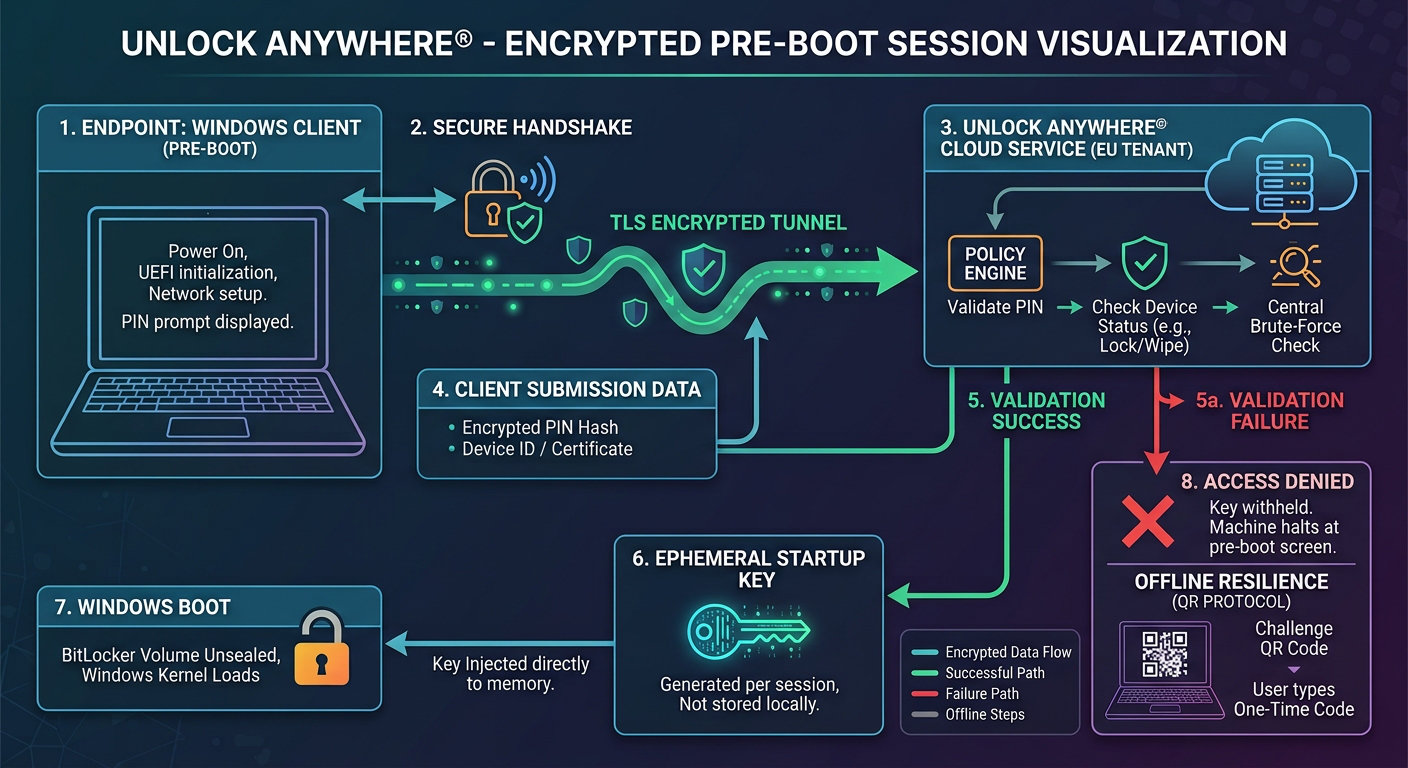
This reveals a common compliance dilemma: while network traffic and access events are logged down to the second, the verified security posture of mobile Windows endpoints during physical loss remains largely invisible.
Native TPM PIN vs. Unlock Anywhere® Server-Verified PIN
| Dimension | Native BitLocker TPM+PIN | Unlock Anywhere® Server-Verified PIN |
|---|---|---|
| Validation Authority | Local motherboard TPM 2.0 | Centralized Unlock Anywhere® Cloud Tenant |
| Revocation Velocity | Requires OS boot / physical access | Instant via Cloud Console (1 click) |
| Brute-Force Defense | Chip-dependent TPM hardware throttling | Central cloud lockout, immediate SOC alerting |
| Credential Rotation | High friction; requires scripts running inside OS | Centrally enforced via cloud policy or self-service |
| Key Exposure | VMK sealed inside local physical silicon | Key remains off-device until validated |
| Audit Trails | Local Windows Event Logs (post-boot only) | Real-time pre-boot telemetry for every start attempt |
Maintaining Resilience: The Offline QR-Code Protocol
A common concern with server-side validation is field reliability: What happens when a consultant or field technician boots up in an airport or basement without an active Wi-Fi or Ethernet connection?
Unlock Anywhere® handles this through an integrated Challenge-Response QR Protocol:
- If no network adapter can reach the cloud service, the pre-boot interface displays an encrypted, dynamic QR code containing the session challenge and device state.
- The user scans the QR code using their registered mobile authenticator or browser.
- The user inputs their Server PIN into the mobile portal.
- The Unlock Anywhere® cloud authenticates the user, confirms the device has not been flagged for lock or wipe, and generates a one-time cryptographic boot code on the mobile screen.
- The user types the code into the client to start Windows.
Even without direct network connectivity on the PC, security integrity remains intact: the startup key is never accessible offline without server-side policy clearance and PIN verification.
Regulatory and Compliance Impact
Shifting to server-validated pre-boot authentication aligns directly with stringent global and European cybersecurity directives:
- NIST SP 800-63B (AAL2 / AAL3): Follows the NIST multi-factor principles by providing two-factor authentication at pre-boot by coupling physical device enrollment (possession factor) with a server-authenticated secret (knowledge factor).
- NIS-2 Directive (Article 21): Helps meet requirements for active cryptographic key management, dynamic access control, and incident logging on distributed and operational hardware.
- ISO/IEC 27001 (Controls A.5.11, A.8.1, A.8.24): Proves asset protection and cryptographic enforcement. Every boot attempt, failed PIN entry, and lockout event is recorded with an immutable timestamp in the centralized audit trail.
Availability
The Server-Verified PIN feature is available immediately across all existing and new Unlock Anywhere® tenants as part of the core client licensing, requiring Windows Professional/Enterprise and standard TPM 2.0 hardware.
To evaluate Server-Verified PIN, Remote Lock, and Remote Wipe in your staging environment, sign up for a 45-day evaluation for up to 5 clients.